Wednesday, April 16, 2008

Community Libraries Project

I've been working with three organizations in my village to create libraries that meet their needs. My lower primary school (grades K-4) has some books and we're working on organizing them in the computer room so some students can read while others use the computers and then swap half way through the period. The Phokwane Improvement League Rural Education Trust (PILRET) has a fairly large collection that our friend Katie and I recently finished organizing with the project manager Shocky. (By finished, I mean we finished with the hundreds place for dewey decimal and the Fiction section. We still need to do the tens and ones.) Shocky and I have sat down and planned our next moves for creating a library committee and making note cards for all the books. If everything goes according to plan, the community library will open in June. My other primary school (grades K-7) wants to get their learners reading more, but the only books they have are about 30 National Geographic photo journals of North America.

Luckily, fellow volunteer Rose Zulliger has been working on getting libraries for her schools and received a donation from Books for Africa of 35,000 books. She's sharing this bounty with me and 16 other volunteers. My primary school with the National Geographics is going to receive 1,100 books!

But we need your help. Each school is raising R1,500 (about $225) to help transport the books in a crate across the ocean. We need to raise another $5,000 to get it there. Rose has put together a Peace Corps Partnership Program grant to get that money. The grant is supported by individuals in the United States who can donate to projects of their choice on the Peace Corps website.

Please consider supporting this project. Thirty schools are receiving over 1,000 books each and all have Peace Corps volunteers to help the schools impliment and utilize the books. All schools had to submit a grant proposal in order to receive the books. The website for making a donation is here: https://www.peacecorps.gov/index.cfm?shell=resources.donors.contribute.projDetail&projdesc=674-045. Any amount helps, because we have the resources of 17 volunteers, so small donations will go a long way.

When all three libraries are operating, we hope to create an interlibrary loan system so members of any library can use all three with only one library card. We're very excited about this project!

Longtom Marathon

A big thank you to everyone who sponsored Jennie and I in the Longtom Marathon. Together, KLM raised $20,350 to send needy learners to a great private school in Mpumalanga province. We had a lot of fun running it with our friends and having an excuse to get together with them for a good cause.

I ran about half of the half marathon before my knee started really hurting and then spent some time both walking and running for the rest of the race. I was able to sprint into the finish line with a very ugly face.


I finished in 400th place with a time of 2:18:43.

Jennie walked the half marathon with our friend Katie and had a great time, though her feet were understandably tired.

Our own Adam Bohach ran the ultra marathon of 56km and came in 11th overall out of at least 467 runners - it was his first marathon. Good grief!

Wednesday, March 26, 2008

Plodding along

The sky is almost
               endless
just like the pain
               of children
the loss of hope

The bird of poverty sits on their necks
   tighter, tighter

but it too will soar
                  eventually
into the almost
               endless
               sky

   "Are you happy there?"
          "no,
                not really"

  But
I now feel I have a
    purpose

  dangling,
          dancing
beside me

I run in circles
  to entertain

I just want to make
    a difference

  But
now I have met people I
       cannot
walk away from

I have met hearts
that will always be a part
of mine

I have experienced a
     life
that will sway
   me forever.

a boy

He has become a
      man
   before his feet
                      reach
        the ground.

His eyes glaze from all of the
   pain
he has
       endured
in his
     five
          long
               years


barely a
    sound
  does he
          leak
scooping rice
fistful by fistful

this may be the last
     meal
        today

The ride home

We have been in South Africa for a little over 8 months! In seems that the weeks fly by, but sometimes the hours and days drag on. It is interesting to look back to how we felt in July compared to how were are doing now. I can really see a growth in both of us.


I would like to share a story about a semi-recent event:
I went to a near-by city to visit one of my good friends last month. At the end of the day,in my excitement, I decided that I would like to stop in the Pick N Pay in hopes of finding some goodies that we cannot find near our village. I certainly found some goodies, but I ended up staying in the store a little too long. The next thing I knew, the speakers were calling all shoppers to the front as it was closing time (it was 5p). After I picked up some soy sauce, I headed up to the cashier to wait in a very long line. After I was checked out, I left the convenience of the mall to the harsh, noisy, dirty taxi rank across the street. As I walked out the door, I realized that the sun was about to start setting. I would not have thought anything of it, but I had to pass into a township where I would catch the next taxi going to our village. The township was not one that I liked in the daytime, much less felt comfortable navigating in the darkness.

I found the taxi I needed to go on and only saw one other woman waiting inside at which point I started to get a little nervous as this guaranteed that I would arrive in the township after dark. As I had no other option, I found a seat in the taxi and waited. After a few minutes, more people started to take their seats in the taxi. One of these people was a woman who sat next to me and started to chat. She asked me what I was doing in South Africa and I told her that I was a volunteer. And she said "are you a Peace Corps Volunteer?" I was shocked. People rarely understand my garbled explanation of what I am doing in South Africa. She said that she knew a Peace Corps Volunteer from 6 years ago who worked at the school she where she is currently teaching. She told me that he held a workshop for the teachers where she learned a lot of good information. She was able to tell me about his character and it was clear that he had an impact on her life. This really made me think about our jobs here because sometimes it does not feel like we are really making as much of an impact as we would hope. The truth is that every single person impacts more people than they will ever know. We may never know the impact we have on others.

After our conversation, she asked me where I was going and when I told her she spoke with the driver to make sure that he would drive me straight to the next taxi that I would need to catch. She also asked around on the taxi and we found out that three other women were also going to the same area. We all decided to look out for each other and make sure we were safe. Sometimes my independent side comes out and I do not feel like I need to be looked after every second, but at this moment, I realized that I have not felt so cared for and accepted by perfect strangers.


Love,
Jennie

Thursday, March 20, 2008

How to Eat a Mango

Back home in the US, Jennie and I once tried a mango. We used a knife to cut it in quarters around the flat pit and then skinned it.

Friends, there are better ways to eat a mango, and you don't even need a knife.

The video is poor quality because we're uploading on a dial-up connection. The good news is, those of you still living in 20th century America (mom, dad, aunt Stevie) will be able to view the video on your slow dial up connections as well.

Sunday, March 2, 2008

Our New Home

Four weeks ago, we bade farewell to our home with the Nchabeleng's.
While we loved the family and the neighborhood we were living in, we found it too difficult to acclimate to cooking, sleeping, and living in a single room. Though our basic needs were exceptionally addressed, we have realized the necessity of having a place where we can feel at home and comfortable with some privacy.

We now live on the other end of town in a more rural area. We no longer enjoy the comforts of a bathtub and flush toilet, or a washing machine. We pump our water by hand, are again taking bucket baths and hand washing clothing. We are loving it. While the Peace Corps has always told us "don't have any expectations," these were things we expected to experience while living in South Africa.

The small house we now live in is about 100 sq ft more than the room we were in before, but there are two rooms and a thatch roof. The kitchen windows look out over the family corn field and each night we can watch the sun set on the village.


One of my principals was a great help in assisting us to find new housing. She and Jennie walked through this part of the village while I was away at an in-service training (IST) in Zeerust. They found a few houses, but they were similar to our situation at the time - one smaller room close to the main house. My principal asked a woman at work on her mealie crop if she knew of any accommodations available in the area. She pointed across the landscape, saying "the retired policeman on the hill, he has rooms available." The old man didn't hesitate when asked, he understood our purpose in the village and immediately showed Jennie and Ms. Thamaga the two rooms.

When I returned from IST, I went to introduce myself and see the rooms. My principal also suggested I sweep it out so it looked nice when my supervisor from Peace Corps came to check it out. When I arrived, they had already swept it out, someone was hanging curtains, and they had called an electrician to fix the lights and outlets. Our supervisor approved our move the following week.

Our family has been very welcoming but also allowed us a great deal of privacy. The grandfather is a retired police officer and the grandmother is originally from Botswana. She speaks a little English,but most of our conversations are in the native language which we sometimes understand and other times eventually figure out. To complicate our communication, she speaks seTswana, the language of Botswana and North West Province in South Africa. It is very similar to Sepedi, spoken here in Limpopo, but as we are still learning the language, to hear the seTwana adds a twist.

Grandfather's grandfather was the khoši (chief) who founded our village, and his father founded a nearby "suburb" of the village. He gets a kick out of the fact that two of his biological grandchildren have the names Monare and Bontle, the same African names we were given.

Wednesday, February 20, 2008

The Big Question

Although it appeared to be a massive failure, my first success as a Peace Corps volunteer was after two months of living in my community.

My Associate Peace Corps Director (APCD) gave all education volunteers the suggestion to hold a meeting with the School Governing Body (SGB) at each school to get an idea of what projects I could work on for the next two years. SGBs are similar to school boards, except each school has one instead of each district, as it is in the United States. They could also be compaired to PTAs, as the SGBs consist of parents of the attending students, teachers, and the principal.

My first attempt at this assignment was a meeting scheduled with the SGB at Phokwane Primary. I planned to facilitate a discussion using what we in the development business call the appreciative inquiry approach.

There are two basic approaches to development I'm familiar with. The first is needs based. A group or organization enters a community or organization and ask "what do you need?" The answer might be a clinic, a school, mosquito nets, medicine, etc. The organization then provides that need and, (usually) seeing their job as completed, leave.

The second approach is based on building a community's capacity to grow and improve on their own. The group or organization is asked by the development organization "what do you excel at? When is your organization most successful and a beacon in the community?" From there, they are asked what they would dream their organization or community could become, to invision their potential. An action plan is created and it is caried out. The process is cyclic.

Both of these approaches have their benefits. A community can not improve if its members are dying from mosquito bites. Likewise, a community cannot become self-sufficient if they are indefinitely receiving outside assistance.

Using tools provided to us during our training, I prepared questions to ask the parents using a method called participatory analysis. This line of questioning would help me learn more about the community and the feasibility of starting certain projects at certain times.

I arrived at 9:30 for the meeting scheduled at 10:00 which started at 11:00. It was what I had expected, and had brought a book, but was too nervous to read. My Sepedi was not yet at a point where I could use it to ask the kind of questions I had planned, and I've had poor experiences with white, English speaking individuals facilitating a room of black South Africans - the history of apartheid is still very present. Participants have been emotionally beaten down for the majority of their life. I wouldn't be quick to participate in a discussion lead by my former oppressor either.

My principal introduced me to the group. Sweat was running down by back, though it was not a particularly hot day. Mr. Madihlaba had struggled to get their participation during his part of the meeting, so I was particularly apprehensive about my chances of a successful discussion.

I began asking about the seasonal calendar, if there were times of the year when community members were more or less available - were they planting or harvesting at certain times of the year and less likely to be available to assist with community projects?

Educators talk about wait time. If you're willing to wait, usually you'll get an answer. This is true 99% of the time. So I asked the question and then I waited.

And waited.

Unfortunetly, one percent is still one percent. And people in Africa have been waiting a long time. With a nervous chuckle, I cut to the chase.

"What is it about Phokwane Primary that makes it such a great school? Why did you choose to send your children here instead of Thotaneng or one of the other area primary schools?"

I asked this while all around us the walls were crumbling. The classroom two doors down had its roof blown off in a storm four years ago and had never been repaired. Across the school yard, a classroom was unattended because its teacher was busy at the SGB meeting. I waited.

"The discipline is good," a parent said.

Finally, a response. I pushed her further.

"What specifically about the discipline is good? The punishments? The behaviors that are disciplined?" The head of department translated my questions.

I waited.

"The teachers discipline well."

I didn't know where to go. Maybe with more follow up questions I could have reached an answer that pointed us somewhere. Maybe I was too nervous, spoke too much English, and possessed too little experience. I moved on. We identified some possibilities. A teacher mentioned a garden. The meeting ended with the agreement that we could try the discussion again in January - but the meeting never happened. We ate lunch, and I went home disappointed.

The next morning I rode my bike to Phokwane with the hope of meeting with Mr. Madihlaba, debriefing the meeting, and then I had scheduled to observe some teachers teaching their classes.

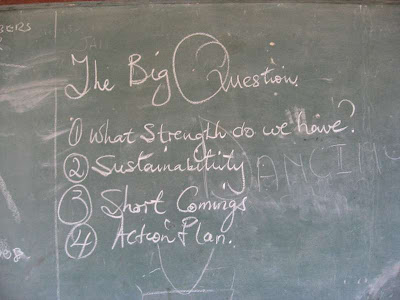
I parked my bike in an empty classroom and found the notes for the School Management Team (SMT) meeting on the board.

From The Big Question


Mr. Madihlaba had modeled the administration meeting off of my discussion.

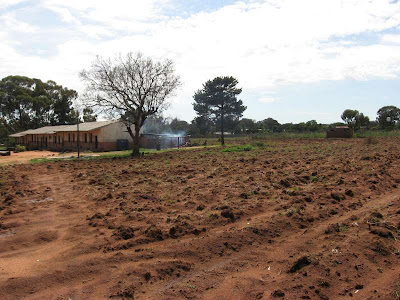
All the teachers were in a faculty meeting that morning. I missed out on observing the classes because the teachers were planning. The next day the school yard was plowed and seeds were planted. The teachers made a garden to suppliment school lunches with vegetables.

From The Big Question


Not the improvement I wanted to see, but what I wanted was unimportant. It was the improvement the teachers wanted. And though the garden is currently being eaten by insects, it is still one of the most tangible signs of my arrival in this village.

Friday, February 15, 2008

Tapola e Golo Kudu (The Very Big Potato)

While Jennie was in Pretoria for medical appointments in January, I singlehandedly ate a huge potato in a single sitting. Seriously, it was very large. I preserved the feat for posterity and included a nickel in the pictures to demonstrate the potato's unusually large size.


This is definitely going in my description of service.