Showing posts with label Success Stories. Show all posts

Wednesday, June 11, 2008

One Year Update

It is getting cold here! The mornings and evenings I can't seem to warm up. We bought a space heater just yesterday, an appliance almost every household owns. There are ventilation ducts in the walls of the houses that let in all the cold air. Bathing is now my least favorite activity of the day.

With the coming of winter, the semester is ending at my two schools, which means students are taking exams and teachers are working very hard to keep up with all the grading they have to do. While in the United States teachers can plug all of a term's grades into a spreadsheet, the teachers here are doing grades for all their students by hand. For 50 students in each class! Then they have to transpose all those grades onto report cards, again, by hand. It's a lot of work and they are very busy.

Which means I am not very busy. Few teachers want to work on pedagogy when they have a deadline looming. So lately I've been preparing for some upcoming projects beginning next month.

The first is a lifeskills day camp for youth in grades four through seven. I've recruited 10 volunteers from the local secondary schools to staff the camp, and we're starting training on 2 July. Camp will open on 7 July and run for one week. We're going to try to keep it limited to 56 campers, 14 per grade. Each day focuses on a theme like HIV/AIDS, making friends, or goal setting. Campers rotate through four program areas: Computers, Lifeskills, Creative Problem Solving, and Sports & Games. Right now I'm working on lesson plans for each program area for each of the five days. I'm also trying to get donations for food so we can serve lunch to the kids. That may or may not happen, but either way, we can tweak with the camp times to make it work out.

Provided everything goes relatively smoothly this first time, we'll run the camp again when school is out in October, then again in December and so on. Ideally, the youth volunteers will gain experience and take everything over when Jennie and I leave so it becomes a sustainable project. Most of our program supplies are either something we already have, like the soccer balls for Saturday sports, or pieces of trash, like old egg cartons for the egg drop challenge in creative problem solving. A lot of the ideas for camp I took from AJ, who did a chess/problem solving/lifeskills camp back in December.

The other major upcoming project is co-teaching grade 7 English. This is fun for me because I get to do some lesson planning and get back in the classroom, but hopefully will also help to share some new teaching methods with my counterpart who is teaching with me. So we're both planning units and I'm going to share some different theories with him every week like Maslow's heirarchy of needs, Bloom's taxonomy, or differentiation. I'll be posting a lot about that over on my education blog, Pedagogy in Practice.

This past quarter I've continued a couple projects from earlier in the year. Jennie already mentioned that we're still doing the Phokwane Youth Sports League, and the library/college guidance center is coming along, though maybe not on the original schedule. We did help them form an interim committee to organize and open the library, and they're now meeting twice a month and holding community meetings to get everyone's opinion on various policies the library will have. We finally finished organizing all the books by their DDC call numbers and have all the subject cards written for the card catalog. Jennie found contact information for all the colleges and sent them an e-mail back in March, and we've been receiving large envelopes of admission requirements and college applications ever since. So I'm not sure if we'll open next month or next year, but we're definitely on the right track.

Back in February I taught the teachers how to use their computers and in April and May I helped four teachers take their classes to the computer lab. The students are so excited to get to use them - the school has had them for four years now! I walked into one class and all the kids started dancing and murmuring "Yes! Yes!," knowing it was computer time.

As we reach the one year mark, our idealism has diminished a little from what it was. Two years seems like such a long time to "make a difference," but in reality we have very little time. It's hard for me to look around and ask, "what have I accomplished thus far?" Tangibly, not very much. And it's hard to say how much of all this will be sustainable once I leave. But, I know some of the youth here will never forget playing games on sunny Saturday afternoons with a couple makgowa, and maybe that will be enough to make a small difference. I suppose I'll never know.

Wednesday, February 20, 2008

The Big Question

Although it appeared to be a massive failure, my first success as a Peace Corps volunteer was after two months of living in my community.

My Associate Peace Corps Director (APCD) gave all education volunteers the suggestion to hold a meeting with the School Governing Body (SGB) at each school to get an idea of what projects I could work on for the next two years. SGBs are similar to school boards, except each school has one instead of each district, as it is in the United States. They could also be compaired to PTAs, as the SGBs consist of parents of the attending students, teachers, and the principal.

My first attempt at this assignment was a meeting scheduled with the SGB at Phokwane Primary. I planned to facilitate a discussion using what we in the development business call the appreciative inquiry approach.

There are two basic approaches to development I'm familiar with. The first is needs based. A group or organization enters a community or organization and ask "what do you need?" The answer might be a clinic, a school, mosquito nets, medicine, etc. The organization then provides that need and, (usually) seeing their job as completed, leave.

The second approach is based on building a community's capacity to grow and improve on their own. The group or organization is asked by the development organization "what do you excel at? When is your organization most successful and a beacon in the community?" From there, they are asked what they would dream their organization or community could become, to invision their potential. An action plan is created and it is caried out. The process is cyclic.

Both of these approaches have their benefits. A community can not improve if its members are dying from mosquito bites. Likewise, a community cannot become self-sufficient if they are indefinitely receiving outside assistance.

Using tools provided to us during our training, I prepared questions to ask the parents using a method called participatory analysis. This line of questioning would help me learn more about the community and the feasibility of starting certain projects at certain times.

I arrived at 9:30 for the meeting scheduled at 10:00 which started at 11:00. It was what I had expected, and had brought a book, but was too nervous to read. My Sepedi was not yet at a point where I could use it to ask the kind of questions I had planned, and I've had poor experiences with white, English speaking individuals facilitating a room of black South Africans - the history of apartheid is still very present. Participants have been emotionally beaten down for the majority of their life. I wouldn't be quick to participate in a discussion lead by my former oppressor either.

My principal introduced me to the group. Sweat was running down by back, though it was not a particularly hot day. Mr. Madihlaba had struggled to get their participation during his part of the meeting, so I was particularly apprehensive about my chances of a successful discussion.

I began asking about the seasonal calendar, if there were times of the year when community members were more or less available - were they planting or harvesting at certain times of the year and less likely to be available to assist with community projects?

Educators talk about wait time. If you're willing to wait, usually you'll get an answer. This is true 99% of the time. So I asked the question and then I waited.

And waited.

Unfortunetly, one percent is still one percent. And people in Africa have been waiting a long time. With a nervous chuckle, I cut to the chase.

"What is it about Phokwane Primary that makes it such a great school? Why did you choose to send your children here instead of Thotaneng or one of the other area primary schools?"

I asked this while all around us the walls were crumbling. The classroom two doors down had its roof blown off in a storm four years ago and had never been repaired. Across the school yard, a classroom was unattended because its teacher was busy at the SGB meeting. I waited.

"The discipline is good," a parent said.

Finally, a response. I pushed her further.

"What specifically about the discipline is good? The punishments? The behaviors that are disciplined?" The head of department translated my questions.

I waited.

"The teachers discipline well."

I didn't know where to go. Maybe with more follow up questions I could have reached an answer that pointed us somewhere. Maybe I was too nervous, spoke too much English, and possessed too little experience. I moved on. We identified some possibilities. A teacher mentioned a garden. The meeting ended with the agreement that we could try the discussion again in January - but the meeting never happened. We ate lunch, and I went home disappointed.

The next morning I rode my bike to Phokwane with the hope of meeting with Mr. Madihlaba, debriefing the meeting, and then I had scheduled to observe some teachers teaching their classes.

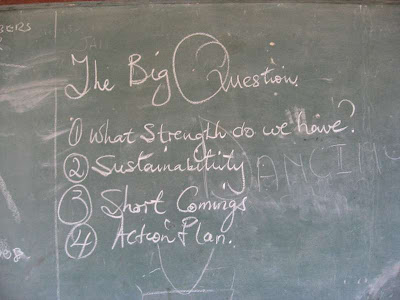
I parked my bike in an empty classroom and found the notes for the School Management Team (SMT) meeting on the board.

From The Big Question


Mr. Madihlaba had modeled the administration meeting off of my discussion.

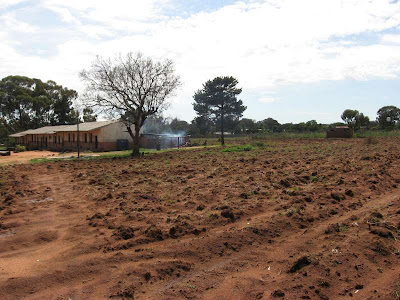
All the teachers were in a faculty meeting that morning. I missed out on observing the classes because the teachers were planning. The next day the school yard was plowed and seeds were planted. The teachers made a garden to suppliment school lunches with vegetables.

From The Big Question


Not the improvement I wanted to see, but what I wanted was unimportant. It was the improvement the teachers wanted. And though the garden is currently being eaten by insects, it is still one of the most tangible signs of my arrival in this village.