Wednesday, March 26, 2008

The ride home

We have been in South Africa for a little over 8 months! In seems that the weeks fly by, but sometimes the hours and days drag on. It is interesting to look back to how we felt in July compared to how were are doing now. I can really see a growth in both of us.


I would like to share a story about a semi-recent event:
I went to a near-by city to visit one of my good friends last month. At the end of the day,in my excitement, I decided that I would like to stop in the Pick N Pay in hopes of finding some goodies that we cannot find near our village. I certainly found some goodies, but I ended up staying in the store a little too long. The next thing I knew, the speakers were calling all shoppers to the front as it was closing time (it was 5p). After I picked up some soy sauce, I headed up to the cashier to wait in a very long line. After I was checked out, I left the convenience of the mall to the harsh, noisy, dirty taxi rank across the street. As I walked out the door, I realized that the sun was about to start setting. I would not have thought anything of it, but I had to pass into a township where I would catch the next taxi going to our village. The township was not one that I liked in the daytime, much less felt comfortable navigating in the darkness.

I found the taxi I needed to go on and only saw one other woman waiting inside at which point I started to get a little nervous as this guaranteed that I would arrive in the township after dark. As I had no other option, I found a seat in the taxi and waited. After a few minutes, more people started to take their seats in the taxi. One of these people was a woman who sat next to me and started to chat. She asked me what I was doing in South Africa and I told her that I was a volunteer. And she said "are you a Peace Corps Volunteer?" I was shocked. People rarely understand my garbled explanation of what I am doing in South Africa. She said that she knew a Peace Corps Volunteer from 6 years ago who worked at the school she where she is currently teaching. She told me that he held a workshop for the teachers where she learned a lot of good information. She was able to tell me about his character and it was clear that he had an impact on her life. This really made me think about our jobs here because sometimes it does not feel like we are really making as much of an impact as we would hope. The truth is that every single person impacts more people than they will ever know. We may never know the impact we have on others.

After our conversation, she asked me where I was going and when I told her she spoke with the driver to make sure that he would drive me straight to the next taxi that I would need to catch. She also asked around on the taxi and we found out that three other women were also going to the same area. We all decided to look out for each other and make sure we were safe. Sometimes my independent side comes out and I do not feel like I need to be looked after every second, but at this moment, I realized that I have not felt so cared for and accepted by perfect strangers.


Love,
Jennie

Thursday, March 20, 2008

How to Eat a Mango

Back home in the US, Jennie and I once tried a mango. We used a knife to cut it in quarters around the flat pit and then skinned it.

Friends, there are better ways to eat a mango, and you don't even need a knife.

The video is poor quality because we're uploading on a dial-up connection. The good news is, those of you still living in 20th century America (mom, dad, aunt Stevie) will be able to view the video on your slow dial up connections as well.

Sunday, March 2, 2008

Our New Home

Four weeks ago, we bade farewell to our home with the Nchabeleng's.
While we loved the family and the neighborhood we were living in, we found it too difficult to acclimate to cooking, sleeping, and living in a single room. Though our basic needs were exceptionally addressed, we have realized the necessity of having a place where we can feel at home and comfortable with some privacy.

We now live on the other end of town in a more rural area. We no longer enjoy the comforts of a bathtub and flush toilet, or a washing machine. We pump our water by hand, are again taking bucket baths and hand washing clothing. We are loving it. While the Peace Corps has always told us "don't have any expectations," these were things we expected to experience while living in South Africa.

The small house we now live in is about 100 sq ft more than the room we were in before, but there are two rooms and a thatch roof. The kitchen windows look out over the family corn field and each night we can watch the sun set on the village.


One of my principals was a great help in assisting us to find new housing. She and Jennie walked through this part of the village while I was away at an in-service training (IST) in Zeerust. They found a few houses, but they were similar to our situation at the time - one smaller room close to the main house. My principal asked a woman at work on her mealie crop if she knew of any accommodations available in the area. She pointed across the landscape, saying "the retired policeman on the hill, he has rooms available." The old man didn't hesitate when asked, he understood our purpose in the village and immediately showed Jennie and Ms. Thamaga the two rooms.

When I returned from IST, I went to introduce myself and see the rooms. My principal also suggested I sweep it out so it looked nice when my supervisor from Peace Corps came to check it out. When I arrived, they had already swept it out, someone was hanging curtains, and they had called an electrician to fix the lights and outlets. Our supervisor approved our move the following week.

Our family has been very welcoming but also allowed us a great deal of privacy. The grandfather is a retired police officer and the grandmother is originally from Botswana. She speaks a little English,but most of our conversations are in the native language which we sometimes understand and other times eventually figure out. To complicate our communication, she speaks seTswana, the language of Botswana and North West Province in South Africa. It is very similar to Sepedi, spoken here in Limpopo, but as we are still learning the language, to hear the seTwana adds a twist.

Grandfather's grandfather was the khoši (chief) who founded our village, and his father founded a nearby "suburb" of the village. He gets a kick out of the fact that two of his biological grandchildren have the names Monare and Bontle, the same African names we were given.

Wednesday, February 20, 2008

The Big Question

Although it appeared to be a massive failure, my first success as a Peace Corps volunteer was after two months of living in my community.

My Associate Peace Corps Director (APCD) gave all education volunteers the suggestion to hold a meeting with the School Governing Body (SGB) at each school to get an idea of what projects I could work on for the next two years. SGBs are similar to school boards, except each school has one instead of each district, as it is in the United States. They could also be compaired to PTAs, as the SGBs consist of parents of the attending students, teachers, and the principal.

My first attempt at this assignment was a meeting scheduled with the SGB at Phokwane Primary. I planned to facilitate a discussion using what we in the development business call the appreciative inquiry approach.

There are two basic approaches to development I'm familiar with. The first is needs based. A group or organization enters a community or organization and ask "what do you need?" The answer might be a clinic, a school, mosquito nets, medicine, etc. The organization then provides that need and, (usually) seeing their job as completed, leave.

The second approach is based on building a community's capacity to grow and improve on their own. The group or organization is asked by the development organization "what do you excel at? When is your organization most successful and a beacon in the community?" From there, they are asked what they would dream their organization or community could become, to invision their potential. An action plan is created and it is caried out. The process is cyclic.

Both of these approaches have their benefits. A community can not improve if its members are dying from mosquito bites. Likewise, a community cannot become self-sufficient if they are indefinitely receiving outside assistance.

Using tools provided to us during our training, I prepared questions to ask the parents using a method called participatory analysis. This line of questioning would help me learn more about the community and the feasibility of starting certain projects at certain times.

I arrived at 9:30 for the meeting scheduled at 10:00 which started at 11:00. It was what I had expected, and had brought a book, but was too nervous to read. My Sepedi was not yet at a point where I could use it to ask the kind of questions I had planned, and I've had poor experiences with white, English speaking individuals facilitating a room of black South Africans - the history of apartheid is still very present. Participants have been emotionally beaten down for the majority of their life. I wouldn't be quick to participate in a discussion lead by my former oppressor either.

My principal introduced me to the group. Sweat was running down by back, though it was not a particularly hot day. Mr. Madihlaba had struggled to get their participation during his part of the meeting, so I was particularly apprehensive about my chances of a successful discussion.

I began asking about the seasonal calendar, if there were times of the year when community members were more or less available - were they planting or harvesting at certain times of the year and less likely to be available to assist with community projects?

Educators talk about wait time. If you're willing to wait, usually you'll get an answer. This is true 99% of the time. So I asked the question and then I waited.

And waited.

Unfortunetly, one percent is still one percent. And people in Africa have been waiting a long time. With a nervous chuckle, I cut to the chase.

"What is it about Phokwane Primary that makes it such a great school? Why did you choose to send your children here instead of Thotaneng or one of the other area primary schools?"

I asked this while all around us the walls were crumbling. The classroom two doors down had its roof blown off in a storm four years ago and had never been repaired. Across the school yard, a classroom was unattended because its teacher was busy at the SGB meeting. I waited.

"The discipline is good," a parent said.

Finally, a response. I pushed her further.

"What specifically about the discipline is good? The punishments? The behaviors that are disciplined?" The head of department translated my questions.

I waited.

"The teachers discipline well."

I didn't know where to go. Maybe with more follow up questions I could have reached an answer that pointed us somewhere. Maybe I was too nervous, spoke too much English, and possessed too little experience. I moved on. We identified some possibilities. A teacher mentioned a garden. The meeting ended with the agreement that we could try the discussion again in January - but the meeting never happened. We ate lunch, and I went home disappointed.

The next morning I rode my bike to Phokwane with the hope of meeting with Mr. Madihlaba, debriefing the meeting, and then I had scheduled to observe some teachers teaching their classes.

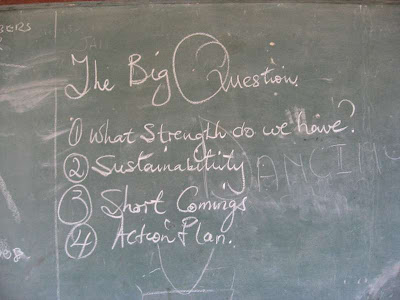
I parked my bike in an empty classroom and found the notes for the School Management Team (SMT) meeting on the board.

From The Big Question


Mr. Madihlaba had modeled the administration meeting off of my discussion.

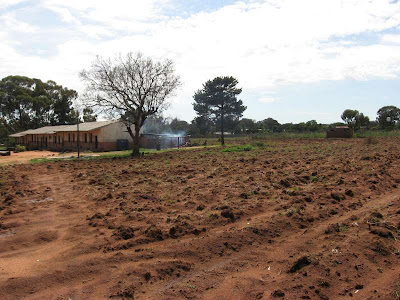
All the teachers were in a faculty meeting that morning. I missed out on observing the classes because the teachers were planning. The next day the school yard was plowed and seeds were planted. The teachers made a garden to suppliment school lunches with vegetables.

From The Big Question


Not the improvement I wanted to see, but what I wanted was unimportant. It was the improvement the teachers wanted. And though the garden is currently being eaten by insects, it is still one of the most tangible signs of my arrival in this village.

Friday, February 15, 2008

Tapola e Golo Kudu (The Very Big Potato)

While Jennie was in Pretoria for medical appointments in January, I singlehandedly ate a huge potato in a single sitting. Seriously, it was very large. I preserved the feat for posterity and included a nickel in the pictures to demonstrate the potato's unusually large size.


This is definitely going in my description of service.

Monday, February 11, 2008

Holiday Vacation 2007 - Wild Coast


The second half of our trip was spent on the south-eastern coast in the town Port St. Johns. This section is called the Wild Coast because of the dangerous winds and sea conditions for ships. The coast is scattered with shipwrecks and unique geological features.

We spent this time with fellow volunteers Ben and Susie Barr-Wilson, another couple from our group. We became good friends with them during training and enjoyed seeing them again.

We spent some time hiking in the forest, on the beach, and in the warm waters of the Indian Ocean. While our guidebook promoted the area as undeveloped and sparsely populated, there sure were plenty of people on the beach on New Year's Day - so many we couldn't get there. We had plenty of time the days before though and it was restful and rejuvenating. Check out the captions for the whole scoop.

If you're still looking for something to read, check out Lisa's blog - she's a friend of ours arriving in Uganda to begin her Peace Corps service - and Jon's blog - another friend in the middle of training for AmeriCorps.

Sunday, February 3, 2008

Holiday Vacation 2007 - Kruger National Park

Jennie and I are back home in Limpopo after holiday vacation. In fact, we've been back for over a month now. We spent five days near Kruger National Park and four days on the coast of the Eastern Cape. Afterwards, we spent a couple days at Peace Corps headquarters in Pretoria doing some research on public colleges and financial aid options for youth in our village.

I'm glad we took a vacation. Even though the initial culture shock is starting to wear off, it was good to get away from the village and all the drastic changes from the life we were living back home. At the same time, it's hard to experience South Africa as a tourist after experiencing it as a resident of a rural village.

Suddenly, the privilege we've tried so hard to shed (or give the illusion of shedding) was donned again like a heavy coat. We were able to save enough in the village to rent a car, stay in bed and breakfasts, and go out to eat often over the two weeks. The lines of communication were cut - our Sepedi was of little use in Seswati speaking Mmpumalanga or the Xhosa speaking coast. We could no longer greet South Africans in their own language and were forced to rely on English, making our skin appear even whiter than it was. But for our overall psychological health, we enjoyed being tourists, even if there was a trade off in our frame of mind.

We spent the weekend before with another Volunteer couple, Brook and Jed. They live in a village near Nelspruit about three hours from our site (six hours by khumbi, as we discovered). It was interesting how different life was for them living near a large city compared to our life in rural Limpopo. We had pizza at the mall, saw a movie, and browsed a book store - things we haven't done since early September. The highlight though wa spending time with the two of them. We played a lot of cards, and received a tour of the area where they live and their organization's office. The two cooked some great food - chicken parmesan, french toast, and eggs with toast.

On Monday, we drove from Nelspruit to the small, mostly Afrikaaner town of Marloth Park, just on the edge of Kruger National Park. We spent Christmas Eve and Christmas being lazy - lying in bed, reading, playing cards. For Christmas dinner we had more pizza.

The 27th we made our first attempt to enter the park. Unfortunately, the place is so overbooked during the holiday season that the gates are open only from 5:30 to 6:30 AM each morning, and a line starts forming at 4:00.

Disappointed, we returned to Marloth Park and drove around the vicinity. Not much of a loss, because we were able to see giraffe, zebra, baboons, and a kudu. I thought I had already seen a kudu - I had seen an antelope with sort of twisted horns the first day we arrived. Impala are not kudu. If a kudu and an impala were in a fight, the kudu would win. I would question whether the majority of lions could take down a kudu singlehandedly. It is the most noble animal I have ever seen. And very large.

We went home, hit the sack at 7:00PM, and got up at 3:00AM the next morning. We got in line at 4:30AM with about five cars in front of us. At 5:20, we were in the first group granted entrance.


That day was incredible. There are very few places where you're allowed to exit your vehicle, but it was amazing how close you could get to the wildlife on the road. Our camera only has a 4x zoom, so you can see from these pictures how close we were. It seemed closer than the zoo to me.

We were lucky enough to spot a cheetah and her cubs in the tall grass, though we were no where near enough to get a good picture. There are estimated to be only 200 in the park.

We ate lunch at a picnic area I read about in our South Africa guide book. It described monkeys gracefully descending from trees to try to steal your lunch. We imagined them climbing down a tree, giving us a puppy dog face and us resisting the urge to toss them a piece of our sandwich. Sounded like a fun time for all involved.

Instead, a veret monkey snuck up from behind and assaulted Jennie in an attempt to knock the apple from her hand. She was unsuccessful, and then spent five minutes staring at us, as if to ask "so, are you going to give me the apple?" Eventually, she scampered off and moments later we heard another one of her victims yelp in surprise.

We did pretty well on sighting the Big Five. We saw a number of elephant and water buffalo. At the end of the day we also saw a rhinoceros. We're fairly confident we caught glimpse of a lion. We did not see any leopard though, but aren't too disappointed. I mean, what are leopards doing in the Big Five? They're not big at all. A giraffe is way bigger. Same with hippos. Both would make better candidates for the fifth of the Five. But I think the best choice would be the kudu.

We left Marloth Park on the 29th, driving south through Mmpumalanga and Kwa-Zulu Natal to meet friends in Durban and tour the Wild Coast. That will be the subject of our another (potentially our next) post.

Longtom Marathon

Hello everyone!
At the end of March Ben and I will be participating in the "Longtom Marathon" which is set up to help raise funds for the KLM Foundation of South Africa. This foundation was set up by two Peace Corps Volunteers during their service in South Africa and is in place to help the youth of South Africa's Mpumalanga Province.

Here is some information about KLM from their website:

Kgwale le Mollo (KLM) Foundation gives educational scholarships to girls and boys from economically disadvantaged, rural communities of the Mpumalanga province to attend secondary school at one of South Africa's leading institutions. The programme emphasizes scholarship and service and as a result, award recipients are talented, motivated young people who wish to better themselves and their country. We recruit young people who want to change their world.

In collaboration with Uplands College, the KLM Foundation offers tuition and maintenance scholarships to young South African students entering secondary school. Each year, one recipient scholar is selected to enroll in the 8th grade at Uplands College. Tuition, room, board, academic fees, travel expenses, tutoring and a modest allowance are provided to the recipient scholar for five years.

If you are interested in finding out more information or sponsoring our participation in the marathon/walk please go to their website: KLM-Foundation.org. The two of us are looking to raise R500 each (about $70). Here is a link directly to the donation page. You will need to indicate our name in the Longtom Marathon section of the page. You can either donate to Ben or myself, they will be splitting the funds evenly between us.

And to be completely honest.....we are not running a full marathon. One of us will be running a half marathon and the other will be mostly walking.

Thank you all for your support and let us know if you have any questions.
Lots of Love,
Jennie and Ben

Monday, January 14, 2008

interview

Still in Pretoria for medical, so here is another post!

One of my friends suggested that I interview South Africans and share their stories with people back home (thanks Sean!) so here is my first instalment.

On my way back from a medical procedure, I asked one of the men who drives the volunteers to appointments what he thought was the most important/best aspect of South Africa that I should share with others. Here is an excerpt (please keep in mind that I tried my best to accurately reflect our conversation but I had been sedated for the appointment and I had not eaten for 30+ hours :)):

What is one of the best aspects of South Africa?

"I would have to say that the best thing about South Africa (you know that we speak 11 languages here?), well the best things is that we all work hard to come together. It is important to learn the languages of each other. Where I grew up, if you wanted to play with the other kids and understand each other you had to learn their language.
The other thing that is good about South Africa is that we fought against an unfair government. We won. All of the Afrikaners thought that there would be a civil war, but that did not happen. Its like if you did something wrong against me yesterday, I should just say 'Jennie, yesterday when you did X, this happened to me' and then we move on. Together. That is the other wonderful thing about South Africa. We are not holding grudges, we are moving forward."


I asked a 15 year old youth in our village what was one thing that Americans should know about South Africa and she said that Americans should know that if you live in a rural area, you have to make your own outside light if you want to see at night. I was thinking about this after our conversation and I don't think either of us realized at the time how profound her statement was. There is a perception of South Africa as the land of shopping malls, cities and crime. But the villages are very different. The villages have a beauty about them, but they are also lacking greatly in resources. It is truly 1st world, 3rd world in South Africa (and it is very clear who is given the opportunities to live in each world). In the villages, if you want to see through the night, you better start constructing your own light.

Lots of love,
Jennie

Thursday, January 10, 2008

tears welling
she lifts my bags
no questions asked


for her
a life

for me
an adventure

no questions asked
i'm stumbling
she lifts.